

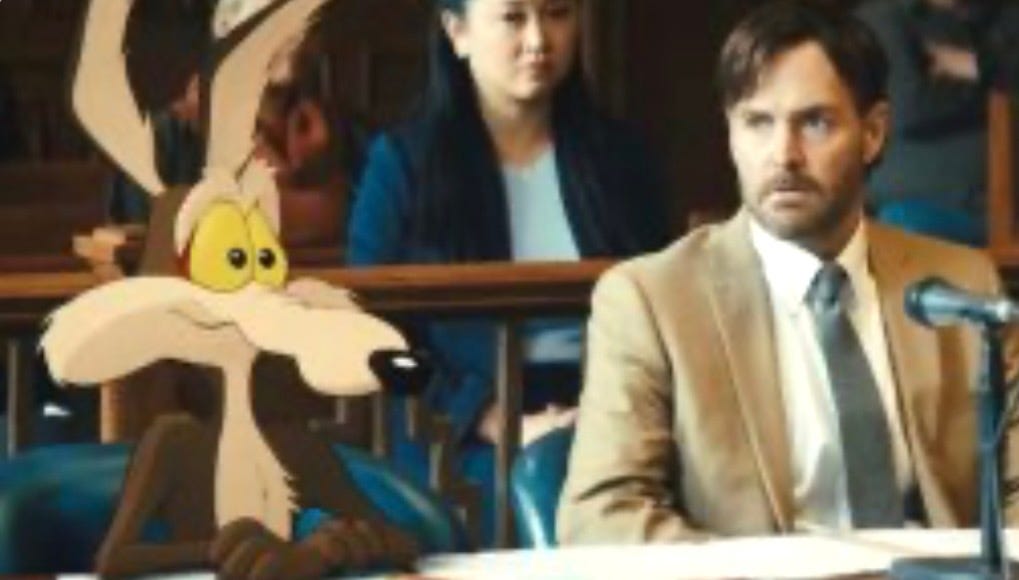
Long before the solipsist-in-chief weighed in on his supposed “high I.Q.,” there was a Looney Tune, a rogue, who hailed himself as a “super genius.”
Yes, Wile E. Coyote, one of the Warner Brothers cartoon characters, traversed the southwest, while Acme products exploded on him, and anvils landed on his head.
Like other villains in history, Wile E. Coyote got caught in his own traps, as will the solipsist-in-chief, who will have his great fall, as I wrote in the HuffPost a decade or so ago in a piece that was in fact titled, “Trumpty Dumpty Will Have His Great Fall.”
Of course, even Wile E. Coyote, a rascal, can change the arc of his life.
One might add that the coyote, like all of us, can change his brand identity or even his soul for the better.
This is another way of saying that no one is beyond redemption.
The Road Runner might chime in with a “beep, beep” at this moment, before he speeds away through a canyon.
Of course, the charming bird, with the speed and guile of Odysseus, has a heart.
And so does Wile E. Coyote, if not the solipsist-in-chief.
As I write about redemption, I do so not long after Yom Kippur.
The Jewish High Holy Day never really ends. But companies and their brand identities, as well as cartoon characters and the rest of us, sometimes do.
Sometimes, we can change for the better. And, sometimes, we don’t.
In Jewish tradition, there is a concept known as cheshbon hanefesh, which is translated as an “accounting of the soul.”
What this means is that Jews are supposed to examine and reflect on our souls on a regular basis, not only on Yom Kippur, the Day of Atonement, the holiest day of the year, which just took place.
As we face our sins, our flaws over the past year and in fact every day, God wants to see us persevere with the Holy Spirit, with love, a fierce love.
This is also true of companies, including those in the creative fields, such as the film business.
When I think of Warner Brothers, I think of the movies from the 1930s and 1940s, movies that I watched when I was a little kid in the early 1970s.
My dad introduced me to those movies in late 1971 when I was 6 years old, a point that I have made before.
This was a stroke of genius, a word that does apply to my father, as I was transfixed by the WB world of Bogey, Cagney and John Garfield, whose films I viewed nearly every Saturday and Sunday for many years.
Featuring tough-talking cabbies and prizefighters, soldiers and racketeers, those films, like Casablanca, Yankee Doodle Dandy, the Bogey-Bacall flicks, boxing pictures, war and espionage films, and urban melodramas, sparked my imagination.
I would never have moved to Los Angeles in 1994, were it not for the love of those old Warner Brothers movies, which, as I say, were ushered into my life by my father when I was a child.
Yes, back then, starting in late 1971, when I was in 1st grade, I watched those tough-talking actors on channel 5, Metromedia TV, then an independent station based in New York, which at that time, in the 1970s, had a deal to show the pre-1950 Warner Brothers library.
The Holy Spirit is eternal, and Yom Kippur, as I said earlier, never really ends.
But, as I also noted, companies and brands do change, and not always for the better.
Channel 5 would later be absorbed by Rupert Murdoch’s NewsCorp, which turned Channel 5 into the Fox flagship in the 1980s.
As for Warner Brothers, I will repeat that, in the 1930s and 1940s, it was the home of Humphrey Bogart, James Cagney and John Garfield, whose protagonists often displayed a level of pluck and resourcefulness as underdogs who fought against and mostly prevailed over evil.
It is also true that some of their protagonists were members of the underworld.
But for all their flaws, the protagonists played, for instance, by Bogey in Casablanca, Dark Passage and Key Largo, never gave up.
They were heroes, in spite of, or perhaps because of, their flaws, their fears, their seeming vulnerabilities, which they overcame with ingenuity, determination, and, yes, the Holy Spirit.
In light of the news that Paramount Skydance, owned by the Ellisons, lackeys to our disgraced chief executive, will be merging with Warner Brothers Discovery, I feel a sense of sadness, even while I retain hope for the future.
I don’t trust the Ellisons at all.
It strikes me as less than honest to believe in the “independence” of a 5-member board, appointed by Paramount, to oversee the editorial policies of CNN.
If I were to assess the Warner brand honestly, I would have to say that Warner Brothers has not consistently demonstrated its original identity as a home of the underdog, since the mid-to-late 1940s when Bogey and Garfield set up their own production entities, and Cagney too started to migrate to other studios.
When I think of the Warner Brothers films that I love so well, I recall the fighting spirit and the wisecracking repartee of the Epstein brothers and John Huston, among other screenwriters and directors, a scrappiness and charm that will always be memorable to me.
But those elements of the Warner brand did pretty much end in the late 1940s.
Of course, it is true that Warner Brothers still made its cartoons, starring the Looney Tunes, such as Bugs Bunny, Daffy Duck and Porky Pig in the 1950s and beyond, cartoons that originated in many cases in the 1930s and 1940s.
Like Bogey, Cagney and John Garfield, Bugs Bunny and the other Looney Tunes characters spoke in the idiom of the old Warner Brothers movies. Bugs and his pals were scrappy, feisty and resourceful.
They could banter, and they did so with panache and irony.
The voices of those characters were created primarily by the inimitable Mel Blanc, who delighted me as much as the aforementioned actors who starred in the WB films of the 1930s and 1940s.
Traces of that Warner Brothers DNA continued to animate the studio into the 1970s when the studio released, for example, Mean Streets, Martin Scorsese’s 1973 crime drama, one of the most influential movies of my lifetime, which introduced many filmgoers to Robert De Niro and Harvey Keitel as well as Scorsese.
Warners also distributed All the President’s Men, starring Robert Redford and Dustin Hoffman as journalists Bob Woodward and Carl Bernstein, a 1976 thriller that riveted all of us, even though we knew exactly how it would end, with the resignation of Nixon, the most disgraced leader of our nation, before the current occupant of the White House, the solipsist-in-chief.
Yes, there was a still a touch of that old Warner Brothers idealism and a love for the underdog in those 1970s pictures.
While Warner Brothers remains one of the most significant studios in the film and TV business, producing shows like Ted Lasso and releasing films like Sinners, it no longer has such a strong brand identity.
In fact, the component of Warner Brothers Discovery that most resembles Bogey, Cagney, John Garfield and Bugs Bunny is not the film or TV studio.
No, the strongest element of WB is CNN, the 24-hour news network created by Ted Turner nearly a half-century ago.
CNN represents the idealism that every journalist, every artist and every concerned citizen should have.
For nearly 50 years, from the time of Ronald Reagan, through 9/11 and the war on terror, during newsworthy events across the globe that have been glorious and not so glorious, CNN, more than any other news network, has shone a light on the truth.
It has many of the best journalists in the field, and what makes these journalists so good is their honor, their fairness and their courage to travel home and abroad to danger zones, to put their hearts and souls and sometimes even their lives on the line, to report on foreign wars and revolutions, environmental disasters, famine, deportation raids, and genocide.
And the journalists at CNN also cover this White House, as they have covered every White House, by speaking truth to power and by doing so with dignity and courage, even when they are banned by the solipsist-in-chief, as they were in the past several days, and even when he threatens to have some of CNN’s anchors fired, as The Guardian reported roughly a year ago.
If a federal judge does not stop the ill-advised merger between Paramount Skydance and Warner Brothers Discovery, CNN will almost assuredly turn into a shell of itself.
It is hard to believe that CNN’s journalists will be allowed to report the truth when the Ellisons answer to Trump, and the solipsist-in-chief answers to Putin, a point that I have made for a decade.
Should the merger go through, CNN will essentially become Trump TV, which in turn will become Putin TV, as I wrote last December when I published a three-part series for Substack.
At that time, I argued against a merger between Paramount and Warner Brothers Discovery, just as I did in another Substack post in June of this year, “Don’t Let Trump ‘Obliterate’ CNN,” in which I called for Rob Bonta and other attorneys general to sue before a federal judge and to do so on behalf of all concerned citizens in this nation and the world, all of us who depend on freedom of the press.
Bonta and 11 other attorneys general did sue to prevent the merger.
But on Monday, September 21, which happened to be Yom Kippur, Bonta and Paramount announced a settlement.
At this point, it appears that the merger will go through, unless a federal judge stops it.
And a federal judge should stop it, not only on antitrust grounds but also on national security concerns.
Even beyond the threat of Trump and Putin bullying the Ellisons, who will bully CNN, there is the more conspicuous national security threat, due to the nearly 50% ownership stake that the royal families from Saudi Arabia, Qatar and Abu Dhabi would have in the merged company.
Clearly, if the merger is not stopped, CNN and Warner Brothers as a whole will no longer be able to report on the news and tell the stories its journalists and filmmakers have long told, stories marked by imagination and courage.
The corruption of Trump, Putin and their stooges might take a few months before it is revealed, but it will happen, and it will happen “soon,” as Humphrey Bogart’s Rick Blaine tells Ingrid Bergman’s Ilsa Lund late in Casablanca.
Bogey’s character is telling Bergman’s that in a matter of time, shortly in fact, she will regret being with him when she could be with and help save Paul Henreid’s Victor Laszlo, who needs her more than Bogey’s character does, even as all of them are members of the resistance fighting the Nazis.
Bogey’s Blaine thinks about the needs of everyone, a point that I have made before in previous pieces, and one might say that he sacrifices himself for a greater good.
At this point in history, we have many new threats.
For one, we have to protect ourselves from A.I., which is an existential threat that could wipe out our species and that is corrupting people young and old with its toxicity.
I might add that the man with the “high I.Q.” should know that “S.I.” already stands for Sports Illustrated, and the concept of “super intelligence” in this case is a well-known misnomer, for there is nothing intelligent or super about the evil of a rogue, autonomous machine that wreaks havoc with the world, a world, of course, that God created.
Even if people do not believe in God, we can all agree that climate change and global warming are real, as the past summer, with its record-breaking temperatures, fires, avalanches, floods and other environmental disasters, has proven beyond a reasonable doubt.
And then there is the evil of the solipsist-in-chief, a wannabe Hitler, Stalin or Putin.
Those of us who are members of the resistance fighting for democracy and freedom of speech, those of us who are standing up to the evil of Trump, cannot allow ourselves to be compromised by the Ellisons, who answer to the wannabe tyrant, who answers to another tyrant, as well as other foreign autocrats with their own agendas.
It is obvious that there will be no “independence” at all for the 5-member editorial board appointed by the Ellisons, sycophants and enablers of Trump.
This is another way of saying that, if the merger goes through, CNN will no longer be the CNN that we know.
It will lose the brand of strength and courage that it has long stood for, as will Warner Brothers.
Still, I retain hope.
I remain hopeful that a federal judge could possibly stop this settlement.
Or, perhaps, one or more of the attorneys general will break away from this agreement.
Or, maybe, Comcast or Netflix or another white knight could reenter or enter the fray and bid only for the Warner Brothers film studio, not CNN, which, of all the WB properties, is the one that must stay truly independent and continue to report without fear or favor.
Of course, there is a greater truth here, and it comes back to my earlier point that Yom Kippur and the Holy Spirit are eternal, even as brands and companies can lose their identity.
Humphrey Bogart made many great pictures at Warner Brothers. As did John Garfield and James Cagney.
It is also true that Bogey won his Oscar for The African Queen, a film he made with John Huston after they had both left Warner Brothers.
John Garfield likewise made two of his best movies at his own production company after he basically left Warner Brothers, Body and Soul, for which he received his only Best Actor Oscar nomination, and Force of Evil, both of which were scripted and the latter directed by Abraham Polonsky, one of the most brilliant artists ever to work in Hollywood.
Bogey, Garfield and Polonsky, like James Cagney, were all patriots and idealists.
They never lost their courage. And they never stopped fighting for the underdog, wherever they worked or even when they stopped working, like Garfield and Polonsky, who were blacklisted.
What Polonsky once said of John Garfield was true of all of them: They kept their streetboy’s honor.
If I may return to the Looney Tunes, I should point out that in the past few weeks Ketchup Entertainment, an independent film distributor, released Coyote vs. Acme, a delightful movie with a mix of animation and live-action.
The film stars Wile E. Coyote, one of the Looney Tunes, as well as many of his colleagues, such as a scientist modeled after Warner Brothers actor Peter Lorre, who co-starred with Sidney Greenstreet and, of course, Humphrey Bogart in Casablanca, The Maltese Falcon and other Warner classics in the 1940s.
Featuring many of the Looney Tunes, Coyote vs. Acme began, as one might expect, as a Warner Brothers film.
But Warner, the studio that once stood for the underdog, gave up on the film, a charming and ingenious picture and one that reminds us of the compassion we should have for every creature, including Wile E. Coyote.
Like Ian Frazier, who wrote the 1990 New Yorker humor column, upon which the movie is based, I always felt badly for and empathized to an extent with Wile E. Coyote.
Yes, he is trying to catch and probably kill the Road Runner, but the coyote is subjected to far too much torment and cruelty.
The animal kingdom is very dear to many of us.
And it is certainly very dear to God, who loves all creatures great and small and all creatures of every species.
What God does not love is a bully, a Goliath.
No, God wants us all to sing a song of love, like David, the shepherd boy, or like the Road Runner, or Wile E. Coyote, who actually does not speak in Coyote vs. Acme.
I will not spoil this film for those who have not seen it.
I will simply say that it warmed my heart.
Sadly, it is also true that Warner Brothers did give up on Coyote vs. Acme, which is directed by Dave Green, voiced by Eric Bauza, a remarkable Canadian voice actor, and stars Will Forte, as well as Wile E. Coyote and other actors and “tunes.”
Yes, Warner Brothers, which originally produced the film, thought that it would not do well at the box office, and so it killed Coyote vs. Acme.
We should all be grateful that Ketchup Entertainment acquired this underdog of a picture, which is one of the most poignant and lively that I can recall seeing in recent years.
It is a tribute to the Warner Brothers cartoons and classic movies from the 1930s and 1940s.
There is no doubt that Coyote vs. Acme reminds me of the love that I had for the WB studio when I was a boy.
But what I really love more than anything else is the Holy Spirit, the imagination and pluck, at the heart of those cartoons and films, the characters who never gave up and who always retained their optimism and hope.
Like Wile E. Coyote and Bugs Bunny, Humphrey Bogart, James Cagney and John Garfield, CNN’s top journalists may have their best years ahead of them, too, even if they might be working for another network or independently.
Shanah Tovah!
Happy New Year!
That’s all, folks!