
Decompressing
Restoring our mental health

A recent cover story in the New York Times Magazine on dissociative identity disorder provided a public service to all readers.
Maggie Jones wrote a brilliant article, which included extensive research and interviews and showed great compassion for people who have the diagnosis and for all of us who grapple with mental health challenges.
Articles like Jones’ help to end the stigma that still exists against those of us who suffer from mental illness.
As readers know, I was diagnosed in the late 1990s with schizophrenia and later schizoaffective disorder.
My psychiatrist subsequently changed my diagnosis to major depression with psychotic features.
He also pointed out years ago that I had endured a major trauma when I was a child and that I had PTSD.
Yes, some of us who have been traumatized when we are children, particularly when that trauma is sustained and savage, dissociate, which is another way of saying that we can drift off into an imaginary world.
As I have written before, dissociating is an evolutionary adaptation, one that takes place subconsciously.
I may never know the precise nature of my diagnosis, whether it is schizophrenia, schizoaffective disorder, major depression with psychotic features, dissociative identity disorder, PTSD or a mixture of the above and other diagnoses.
Not knowing my exact diagnosis is probably okay, because I am stable.
And diagnosing mental illness can be more of an art form than a science, as I wrote years ago.
For some time now, I have been on a very low dose of Vraylar, the lowest, and I don’t take it every day.
I am in therapy, but my therapy sessions do not occur necessarily every week.
While I am an imperfect vessel, a flawed man, and not in perfect health, I am doing fine.
There is no doubt that sometimes I get “my signals crossed,” to quote Bobby Dylan.
Yes, I do get my signals crossed from time to time, including in my writing, and I apologize for these failures.
I own them.
When I make these mistakes and get my signals crossed, I need to remind myself that this is God’s world.
It is not our world. It is not my world.
It is God’s world.
As a wise person told me years ago, we are just caretakers for God while we are here.
I recognize that not everyone believes in God.
And some people, who do believe in God, call Him by different names.
Irrespective of our beliefs, we need to persist, to persevere, to “keep on keepin’ on,” to quote the great Bobby Dylan once more.
That is what God wants to see.
Yes, we need to keep on keepin’ on with love, with a fierce love.
As the Bible and the Kabbalah teach us, God wants us to love Him, to sing Him a song of love.
God is love, as we know.
And I do love God, who, as an omnipresent figure, of course, spans all genders, sexual orientations, races, religions and ethnicities.
While my mental health diagnosis has changed over the decades, my outlook, for all of my challenges, has remained one of optimism.
I will never give up.
And you should not either.
I am grateful to be alive, to live on this planet and in this country at this time in history.
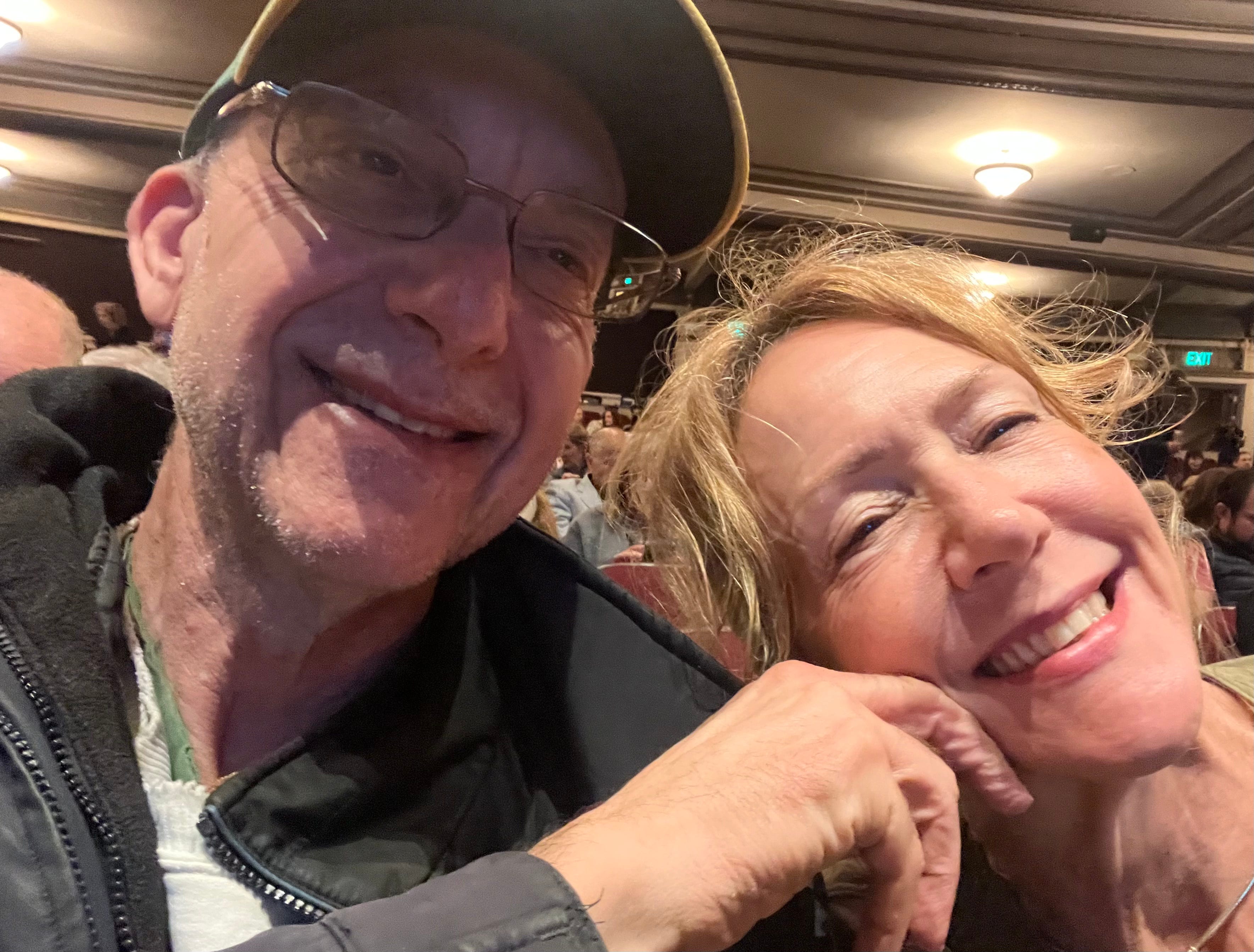
I am blessed to be with Carol, my angelic wife, who nurtures me.
And I have wonderful friends and family.
I am also grateful that we are living at a time when we do have a profession such as psychiatry, when we do have well-trained practitioners with empathy for consumers, and when we still have freedom of the press, freedom of speech, freedom of religion and the right to vote.
We should always protest peacefully for these rights and others.
Our countrymen and women in Minnesota have shown us the way.
They have suffered tragically.
Renee Good and Alex Jeffrey Pretti lost their lives, and they should never be forgotten for the sacrifices they and others have made for us, for our democracy.
I am also grateful that, for all of our flaws as a country and a planet, we have made remarkable strides in reducing stigma against those of us who do have mental health challenges.
As I have long contended, so many of us blend into society, as we have over the millennia.
We have always been here, and some of us function at a very high level in a variety of fields, including journalism, law enforcement, medicine and politics.
Were he alive today, King David, one of the most sublime figures in history, would probably be diagnosed with schizophrenia, dissociative identity disorder, PTSD, major depression, or some disorder that combines psychosis, depression and trauma.
I will never forget reading the Psalms and coming across lines of verse from King David such as these in Psalm 41: “All that hate me whisper together against me: against me do they devise my hurt. An evil disease, say they, cleaveth fast unto him…”
Yes, I relate to King David, who clearly had what some psychiatrists refer to as a “frame of reference” for his fears, for his apparent paranoia, since so many people were jealous of him; so many people lied about and plotted against David, people such as Saul and Absalom, among others, who wanted to kill the shepherd boy who became king.
Many of us who have battled mental illness have been ostracized and defamed, and some of us were traumatized when we were quite young.
For that matter, King David is not the only prophet from the Bible, who was tested by God and who prevailed against evil.
Think of Job, Abraham, Moses, Joseph, Elijah, and, it might be fair to say, Jesus Himself.
Yes, some of us who have grappled with mental health challenges, including hallucinations and delusions, may be closely connected to God.
There is no doubt that God tests all of us. And we all have to show character.
The Lord wants to see that we show our love for Him, that we summon the Holy Spirit, and that we behave well in His world.
God is also empowering us to make good decisions.
Again, not one of us is a perfect vessel.
We all sometimes make mistakes.
I certainly do.
But we can correct those mistakes. We can atone. And we can change our behavior for the better.
Years ago, Dr. Michael McGrail, my psychiatrist, understood, as have my subsequent psychiatrists, that I am on an axis that includes features of depression and psychosis, as well as PTSD.
For the most part, I have handled and continue to handle my diagnosis fairly well.
And I want to give everyone hope that we can all improve our lives and make a positive contribution while we are here.
Indeed, I hope that those people, young and old, who have mental health challenges, remain optimistic.
We can get through this.
The people of Ukraine have been fighting heroically for nearly four years against a dictator, who every day commits an illegal and unconscionable attack on their sovereignty.
And our own country has been subjected to evil, too, by a wannabe dictator and his minions, whose brutal raids and other actions have led to the suffering of so many in the United States and elsewhere.
Again, Renee Good and Alex Jeffrey Pretti lost their lives because of the savage policy of our nation’s leader, who, as we all know, declared roughly 10 years ago that he “could stand in the middle of 5th Avenue and shoot somebody” and still not lose any votes.
In the end, his violence will lead to his own downfall, as I have written for years.
Yes, he and his lackeys will be hoisted on their own petards.
So will the monster, who runs the Kremlin.
As for those of us, who battle mental health challenges, we will continue to make strides in this country and the world.
Like everyone else, we are God’s children.
Of course, we are all just caretakers here on this planet, whether we believe in God or are agnostic or atheist.
This is another way of saying that we all have to behave, whoever we are, even when we dissociate.
And sometimes we also have to decompress, irrespective of our diagnosis.