

You don’t measure a person’s impact based on wins and losses. Life is not about that.
It is about being part of something greater than yourself.
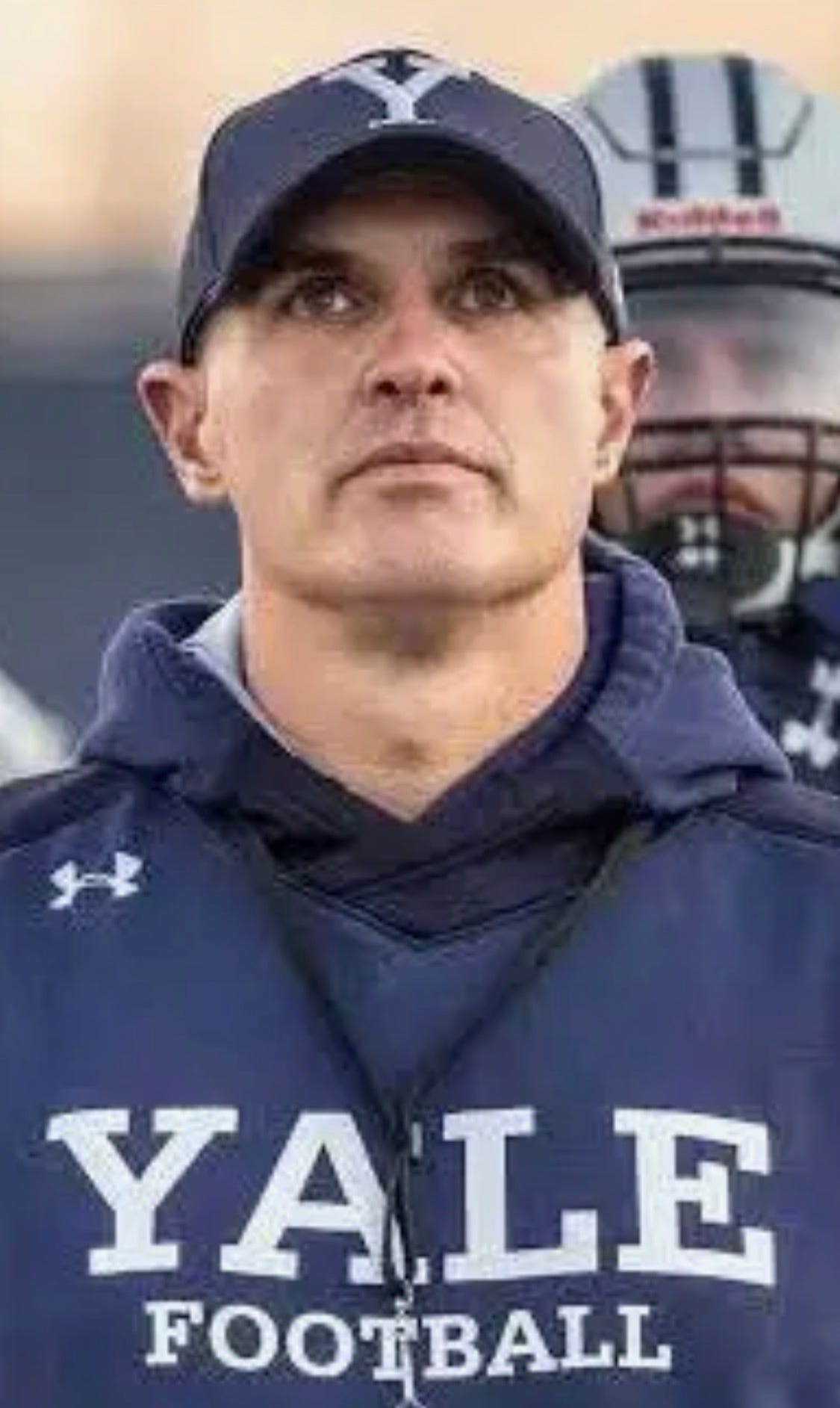
Tony Reno, Yale’s former head football coach, who passed away reportedly from a neurodegenerative disease at 52 on Oct. 2, understood this better than almost anyone.
There is no doubt that he was an extraordinary coach, extremely innovative, strategic and flexible in his play-calling.
And Coach Reno inculcated in his players this ability to adjust, to improvise, while he also taught them a toughness, a fighting spirit.
Yes, Coach Reno, who announced his retirement from the team earlier this year due to the severity of his illness, taught his players and the rest of us, who admired him, that we all need to adapt in life and that we should do so with courage, integrity and honor, especially when we are facing a more highly rated or seemingly formidable foe.
When I watched the Elis play over the past 14 years, I had the sense that Yale’s opponents were not infrequently surprised or even stunned by Reno’s brilliant play selection, as well as the Bulldogs’ determination under their head coach.
Yale won five Ivy League titles during Reno’s 14 years at the helm of the program, which included 2020, during COVID, when the team did not play any matches.
And Coach Reno won 83 games during his tenure as Yale’s head coach, more victories than any other Yale coach since Carm Cozza, who led the Elis for 32 seasons.
But, as I wrote at the outset, it was always clear to me that Coach Reno taught his players about many things far more important than wins and losses.
If I am remembering correctly, Coach Reno told his players many years ago that when they were on the road, he expected them to leave a hotel room better than it was before they got there.
This may seem like a minor point.
But again, if memory serves, Coach Reno insisted that his players clean up their belongings and leave their hotel rooms looking impeccable.
Of course, Coach Reno also expected his players to conduct themselves like gentlemen, like responsible people wherever they were, on the playing field and off, at home and on the road, with their friends and classmates, with their families, and with their opponents.
Coach Reno was teaching his players to be responsible, to hold themselves accountable for their actions, to behave well, and to comport themselves with modesty.
He was a sterling role model for them, as there is no question that Coach Reno evidenced these qualities himself.
I have been a Yale football fan going back to my childhood in New Haven, Conn.
I used to go to Yale games when I was in elementary school, junior high and high school.
In 1983 and 1984, I wrote articles for the Yale Daily News, some of which focused on Yale football.
Over the decades, I interviewed Coach Cozza, Yale’s head coach from 1965-1996, on a number of occasions, including at his office; and I interviewed Coach Jack Siedlecki, Yale’s head coach after Cozza, over the phone and at a press conference.
Siedlecki hired Tony Reno to be one of Yale’s assistant coaches more than 20 years ago.
A native of Massachusetts and a graduate of Oxford High School in the commonwealth, Coach Reno played football at Worcester State College, then later coached at his alma mater, where he also got his Master’s in Education, before he joined the Yale staff under Coach Siedlecki in 2003.
At first, Coach Reno worked with wide receivers at Yale.
Then Reno, who had played free safety in college, worked with defensive backs.
I can recall being at a Yale football practice in 2006 at Clint Frank Field and seeing Coach Reno, dressed in a navy blue Yale sweatshirt, jogging through the mud with his defensive backs, leading them across the field on a rainy day, as they prepared for the season.
I could see the respect that the players had for Coach Reno, whom I will always picture in that unadorned outfit, wearing a dark blue Yale uniform.
He commanded so much respect not only among his players but also in the Ivy League that Harvard hired him away to be one of then-Crimson Coach Tim Murphy’s top assistants for several years, before Yale hired him right back before the 2012 season.
The Yale team struggled in 2012, its first year under Coach Reno, who took over a program that was not doing well.
Yet right away Coach Reno instilled the right values in his players.
He started to rebuild the Yale program, sharing a commitment with his players to be part of a team, part of a community, a commitment that he would never stop honoring.
Yale went 2-8 during that 2012 season, but I remember how Coach Murphy, a very successful coach at Harvard, commented on how Coach Reno, with his innovative play selection and formations, had challenged Harvard with those “different looks” out there on the field when the two traditional rivals squared off in The Game.
Yes, Coach Reno knew how to throw an opponent off-balance, but not with gimmicks.
He did so with humility and brilliance, ingenuity and heart.
In teaching his players to be responsible, to leave things better than they were when they arrived, to be part of something greater than themselves, Tony Reno left us all with a legacy of selflessness, modesty and honor.
Like all Yale fans, I was thrilled when Coach Reno led the Bulldogs to five Ivy championships, as well as seven victories, including the last four in a row, over Harvard.
Few will forget Yale’s come-from-behind victory over Harvard in 2019 when the Bulldogs, led by quarterback Kurt Rawlings, rallied for two touchdowns to tie the contest in the final 88 seconds of regulation.
After Harvard scored in the first overtime, the Elis matched the Cantabs with a touchdown, before Yale prevailed 50-43 in double overtime on a day when some Yale and Harvard students raised awareness about climate change during halftime at Yale Bowl.
Yale’s victory over Harvard under Coach Reno in 2019 reversed a seeming curse that had begun in 1968 when Harvard rallied similarly for two touchdowns to tie Yale at the end of regulation.
Unlike that contest in 1968, the 2019 version of The Game ended conclusively with Coach Reno’s Elis winning, as darkness encroached on the field late in the day.
Yes, that was a great victory for Coach Reno and Yale.
But, more than the victories, I was thrilled with the fighting spirit of the Elis, a testament to the character and unshakable faith of Coach Reno, who blessed his players with determination.
Coach Reno never flagged in instilling his players with that spirit.
After Yale defeated Harvard last season for a share of the Ivy title, the Elis rallied from 28 points behind to defeat Youngstown State 43-42 in the first postseason game Yale played in its history.
This too was a great victory.
But I was also thrilled with how well Yale played against Montana State, like Youngstown State, a highly ranked team in the Football Championship Subdivision (FCS).
Yale lost 21-13 in that second round playoff game, but acquitted itself well by once again rallying for two touchdowns against a football power, which ended up winning the championship in the FCS, formerly known as NCAA’s Division I-AA.
Yale in fact tallied more yards that Montana State in that game, and Joshua Pitsenberger, one of the best running backs in Yale history, who now plays for the Houston Texans, rushed for more than 100 yards, including a touchdown.
In that game, Dante Reno, Coach Reno’s son, threw a touchdown pass for the Elis, who were trailing 14-0 in the 4th quarter before they mounted their comeback against Montana State.
In both postseason games, played on the road, the Elis demonstrated heart, resilience and courage, trademark qualities of Coach Reno, and they did so in surroundings unfamiliar to them.
Coach Reno prepared the team well.
As I wrote earlier, he prepared his players to adapt to situations and to go beyond themselves, so that they could achieve things few believed possible for an Ivy League team.
Yale has a long history in the sport of football, a history that dates back to Walter Camp, a Yale graduate, who founded the modern game in 1876, the year of our nation’s centennial.
Camp, as I have written before, transformed the game of football from a rugby scrum to the sport we know today, by introducing the concepts of the down system, the yardage markers, the quarterback position, penalties, the number of players on the field, as well as the idea of the gridiron itself.
He traveled across the country with his disciples, like Amos Alonzo Stagg and Howard Jones, who brought the game of football to the Midwest, the West Coast, the South and elsewhere.
Tony Reno followed in this tradition and did so with honor and humility.
It is important for us all to keep in mind that it matters how we behave in life, both on and off the playing field.
Sportsmanship and teamwork will always matter.
Life is not about winning and losing.
It is about being part of something greater than yourself, a point, I am sure, that Coach Reno stressed.
If you play the game the right way, with the right values and you do so relentlessly, week after week, season after season, you will succeed.
The wins will indeed come when you play the right way, as taught by Coach Reno.
It is also important to point out that, since its founding, football has been an inherently violent sport.
I am very concerned about the dangers of football, the dangers particularly of head trauma, as I discussed at length in April 2015 in a piece for the HuffPost, “Separated at Birth: Football Coach Tom Parr, Football Founder Walter Camp.”
Players and coaches should all remember how critical it is to play the game as safely and as ethically as possible.
While I never interviewed Coach Reno, I am convinced, as I say, that he taught his players to play football the right way.
Coach Reno had an open and nimble mind as well as a remarkable strength of character, which clearly helped him to adjust, to make thoughtful decisions, and to guide young students with the right values, which will enrich them for the rest of their lives.
Today, Oct. 3, the day after Coach Reno’s passing, Dante, his son, who suffered an elbow injury in the opening game this season, a victory over Holy Cross, came back after not playing against Cornell last week and led Yale to victory over Merrimack.
Dante Reno, who quarterbacked the Elis to the Ivy championship and their historic playoff win against Youngstown State last season, threw four touchdown passes today, as Yale, true to the character of Tony Reno, came from behind to defeat Merrimack in Yale’s first home game of the season.
Today’s performance by the Elis, coached by Kevin Cahill, a former Lehigh head coach, was a fitting tribute to Tony Reno.
The Elis, now led by Coach Cahill, who served as an assistant coach for many years under Coach Reno, played with characteristic grit and determination.
They did not give up. They rallied after trailing by a couple of touchdowns. And they played the game the right way.
These are some of the values that we all need now, whether we are football players, writers or anything else.
There is a dignity that comes from behaving with honor, from persevering through challenges, and from doing so with humility.
This is how we can all build character, by working hard and honestly, day after day, year after year.
Like Tony Reno, we should all strive to leave this world better than we found it.
Coach Reno is survived by Toni, his wife, and their children, Dante, Angelina and Vince.